Friday, August 29, 2008

September Council Meeting Agenda

AGENDA

LEGISLATIVE COUNCIL MEETING

SEPTEMBER 2, 2008

7:00. P.M.

1. CALL OF THE MEETING & TAKING OF THE ROLL

2. PLEDGE OF ALLEGIANCE AND MOMENT OF SILENCE

3. PUBLIC INPUT SESSION

4. CORRESPONDENCE

5. CONSENT CALENDAR

6. APPROVAL OF PREVIOUS MINUTES

7. REPORT OF THE PRESIDENT

8. REPORTS OF BOARDS AND DEPARTMENTS

9. REPORTS OF STANDING COMMITTEES

10. REPORTS OF COUNCIL LIAISONS

11. UNFINISHED BUSINESS

12. EXECUTIVE SESSION

13. NEW BUSINESS:

CONSENT CALENDAR:

The following items have been addressed in Committee and will be considered in toto by unanimous consent:

1. REFUND OF PROPERTY TAXES COLLECTED PRIOR TO 7/1/08 (1)

TOTALLING $133.10

2. REFUND OF PROPERTY TAXES COLLECTED AFTER 7/1/08 (4) TOTALLING

$562.12

3. REFUND OF PROPERTY TAXES FOR CERTIFICATES OF CORRECTION

ISSUED AFTER JULY 1, 2008 AND BEFORE JUNE 20, 2009 (51

TOTALLING $7,457.24

4. TRANSFER OF FUNDS - PUBLIC WORKS- $13,128.86 (Electricity)

INTERNAL TRANSFER (2007-08 Fiscal Year)

5. TRANSFER OF FUNDS - PUBLIC WORKS- $29,767.20(Overtime)

FROM L/C OVERTIME ACCOUNT (2008-09 Budget)

6. TRANSFER OF FUNDS -L/C Office-$4,102. (Accrued Benefits)

FROM E & C ACCOUNT

7. TRANSFER OF FUNDS - TAX OFFICE -$255.(Binding) INTERNAL

TRANSFER

8. TRANSFER OF FUNDS - TOWN ATTORNEY - $200.(Dues/Subs.)

INTERNAL TRANSFER

9. TRANSFER OF FUNDS - REGISTRAR'S OFFICE - $800.(Overtime)

FROM L/C OVERTIME ACCOUNT)

10. TRANSFER OF FUNDS - LIBRARY - $8,700. (Overtime)FROM L/C

OVERTIME ACCOUNT

11. TRANSFER OF FUNDS - PARKS/RECREATION - $5,000.(Equip.Repairs)

INTERNAL TRANSFER

12. TRANSFER OF FUNDS - COMMUNITY SVCS- $1,000. (Overtime) FROM

L/C OVERTIME ACCOUNT

13. APPOINTMENT TO ENERGY USE & CLIMATE CHANGE COMMISSION

(Francis P. Gasparro) FOR A TERM ENDING JULY 31, 2011

14. APPOINTMENT TO THE BOARD OF ASSESSMENT APPEALS (Martin Lambert)

FOR A TERM ENDING JAN. 31, 2011

15. APPOINTMENT TO THE TECHNOLOGY COMMISSION (Lawrence Salay)

FOR A TERM ENDING JULY 1, 2011

16. RE-APPOINTMENTS TO THE QUINNIPIAC VALLEY HEALTH DISTRICT

(Susan Faris) FOR TERM ENDING JUNE 30, 2011

17. RE-APPOINTMENT TO THE SOLID WASTE & RECYCLING COMMISSION

(Amy Ruhlman) FOR TERM ENDING JULY 1,2011

18. APPOINTMENT TO THE FAIR RENT COMMISSION (Margo DeMaio)

FOR TERM ENDING JUNE 30, 2011

19. APPOINTMENT TO THE ETHICS BOARD (Paul Cuozzo) FOR TERM

ENDING JAN. 31, 2012

20. APPROVAL OF BID WAIVER IN FAVOR OF NOLAN'S MONUMENT CO.

$5200. (Plaques for Hamden War Memorial)

21. APPROVAL OF BID WAIVER IN FAVOR OF RFP FOR DESIGN/BUILD OF

LOWER LEVEL OF THE VETERANS MEMORIAL BUILDING

22. APPROVAL OF RETIREMENT PAYMENT (Linda Anderson) $24,533.71

TAX OFFICE

23. RESOLUTION AUTHORIZING THE TOWN OF HAMDEN TO ACCEPT & EXPEND

FUNDS FROM THE BILL & MELINDA GATES FOUNDATION OPPORTUNITY

ONLINE HARDWARE GRANTS PROGRAM

24. RESOLUTION AUTHORIZING THE TOWN TO ACCEPT A DONATION OF A

FLAGPOLE & COMMEMORATIVE PLAQUE FROM THE HAMDEN ELKS PAST

EXHALTED RULERS ASSOCIATION

25. RESOLUTION AUTHORIZING THE MAYOR TO ACCEPT & EXPEND A GRANT

FROM THE WORKFORCE ALLIANCE IN AN AMOUNT NOT TO EXCEED

$61,378. FOR FISCAL YEAR 2008-09

26. RESOLUTION AUTHORIZING THE MAYOR TO ACCEPT & EXPEND A GRANT

FROM THE WORKFORCE ALLIANCE IN AN AMOUNT NOT TO EXCEED

$104,500. FOR FISCAL YEAR 2008-09

27. APPROVAL OF PURCHASE AND SALE AGREEMENT - 2384 WHITNEY AVE.

REGULAR AGENDA:

1. APPROVAL OF RETIREMENT BENEFITS - (Al Savarese) Engineering

Dept. $49,113.90

2. RE-APPOINTMENT TO THE HISTORIC PROPERTIES COMMISSION (William

Doheny) FOR A TERM ENDING SEPT. 30, 2013

3. RE-APPOINTMENT OF ALTERNATE MEMBER OF THE HISTORIC PROPERTIES

COMMISSION (Todd G. Levine) FOR A TERM ENDING SEPT. 30, 2011

4. RESOLUTION OF THE LEGISLATIVE COUNCIL OF THE TOWN OF HAMDEN

CONNECTICUT ADOPTING THE CONNECTICUT CITY AND TOWN DEVELOPMENT

ACT AND AUTORIZING THE TOWN OF HAMDEN TO UNDERTAKE PROGRAMS

AND PROJECTS AUTHORIZED UNDER SAID ACT

5. ORDINANCE AMENDING AN ORDINANCE APPROPRIATING $2,461,300.

FOR VARIOUS PUBLIC IMPROEMENTS FOR FISCAL YEAR 2006-2007 AND

AUTHORIZING THE ISSUE OF $2,461,300. BONDS OF THE TOWN TO

MEET SAID APPROPRIATION AND PENDING THE ISSUANACE THEREOF

THE MAKING OF TEMPORARY BORROWINGS FOR SUCH PURPOSE

6. ORDINANCE AMENDING THE CODE OF ORDINANCES BY ADDING A NEW SECTION

33.67a, ESTABLISHING A FEE SCHEDULE FOR AQUIFER PROTECTION

AREA PERMITS

ADDITIONAL NEW BUSINESS:

1. APPROVAL OF SECOND AMENDMENT TO LEASE AGREEMENT BETWEEN

THE TOWN AND AREA COOPERATIVE EDUCATIONAL SERVICES (ACES)

2. RESOLUTION AMENDING THE 2008=2009 FISCAL YEAR BUDGET

(ENGINEERING/POLICE DEPT.)

3. EMPLOYMENT AGREEMENT - GRANTS ADMINISTRATOR (Florence

Villano)

4. RESOLUTION AUTHORIZING AN AMENDMENT TO AGREEMENT FOR

CONSTRUCTION OF FARMINGTON CANAL GREENWAY PASE III

5. RESOLUTION AUTHORIZING THE NAMING OF 289 PINE ROCK AVE.

IN HONOR OF JOHN CARUSONE

Tuesday, June 03, 2008

Senior Tax Relief Approved !

Tuesday, June 3, 2008

Some Hamden seniors to get $1,000 tax rebate

HAMDEN — When the bills come due July 1, some senior citizens will be getting an extra break on their taxes.

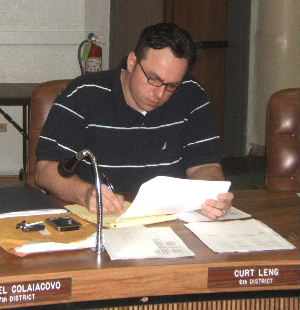
Thanks to a unanimous vote of the Legislative Council Monday night, elderly residents who meet certain income guidelines will get a $1,000 rebate. "I am real proud to say this is the highest senior tax rebate in Hamden history," said Councilman Curt Leng, D-6, who was chairman of the committee that worked on tax benefits for senior citizens and veterans.

Under the new guidelines, single or married people who earn up to $18,250 will get a $1,000 break. Under the old rebate structure, single senior citizens were getting a $550 rebate and a married couple’s tax bill was cut by $600.

For those who earn up to $29,800 if single or $36,500 if married, a $600 rebate will be available as of July 1. Those people had been receiving rebates of $300 to $400.

Advertisement

About 450 seniors are part of the program now. People who believe they are now eligible should contact the assessor’s office, Leng said. "The intent for next year is to increase the income eligibility," he said.

The council covered the $165,000 expected loss in revenue when it planned for the budget that takes effect July 1.

Also Monday night, the council increased the Board of Education’s budget by $821,079 so that a deficit in special education funding can be covered. Of the amount, $432,794 will come from the fund balance. The rest will be reimbursed by the state.

Councilwoman Gretchen Callahan, D-4, asked for a breakdown in the number of special education students who have come into the district since the last fiscal year and how many have been placed out of district. School board Finance Committee Chairman Ed Sullivan said he would provide the council with the information by today.

Superintendent of Schools Frances M. Rabinowitz told the council that school officials continue to study the move of the district’s central office from 60 Putnam Ave. to Hamden Government Center.

She said that she’s not opposed to moving, but needs to ascertain that the town offices have space to accommodate all school officials she needs to have with her on a daily basis.

She also warned the council that there will be costs associated with moving special education administrators and two special education programs for secondary students, STEPS and REACH, from 60 Putnam to Alice Peck School.BIZ

Wednesday, May 14, 2008

Truth Is ... Gambardella is Uniformed

Truth Is … Gambardella is Uninformed

Last week former Councilman Ron Gambardella wrote a letter regarding various subjects mainly focused on the budget and taxes. I wasn’t surprised by the swipes he took at me and some of my fellow Democrats on the Council - this is common in his rants. What did surprise me was the level of misleading information and uninformed opinions he chose to use and attempt to pass onto Hamden residents as fact.

Differences of opinion are good for politics and they are good for government - misleading taxpayers without plan or informed position is not helpful to anyone.
The truth is that Mr. Gambardella didn’t attend ONE budget session out of the 9 nights that the Legislative Council met to work on the budget, nor did he speak at ONE of the 4 different opportunities the public had to speak to the Council regarding the budget. If you don’t show up, then you probably don’t know the facts.

I think it’s incredibly important for Hamden ’s residents to get real facts regarding next year’s budget that we just passed. The following are some highlights of the 2008-2009 budget.

1) The Council was able to produce a very responsible budget, one that keeps us on sound financial footing, with the LOWEST tax increase in 6 years;

2) We lowered the mill rate over a 1/2 mill lower than what was recommended in the Mayor's budget in March;

3) The actual dollar tax increase on the median single family household next year will be $56 for the entire year;

4) We kept our commitment to the Town's Pension Plan, by increasing the contribution to $12.5 million, despite attempts to lower it to $11 million by the Republicans, which would have been less than last year and a reversal of our promise to the public and our financial managers;

5) We made sure to keep Public Safety a priority by funding our Police and Fire Department budgets to allow for proper equipment and personnel;

6) In the budget, we’ve listened to our Town Auditors and other financial experts and responsibly funded our medical self insurance and worker’s compensation - both of which were in poor financial shape just a few short years ago. When these accounts are in peril, it risks the Town bond rating, which has the potential for incredibly negative effect on the interest rate we receive when bonding projects like the new Middle School or the coming Police Headquarters;

As for his personal attacks on me, if Mr. Gambardella had attended even one of the budget sessions, he would know that this year - like most - I was consistently trying to reduce account after account, line by line, in department after department. It is well known for those involved that I rarely see a budget cut that I don’t like.

I try very hard to bring in the tightest budget possible – to spare taxpayers every penny possible. To call me the “ultimate tax and spender” is absurd and would actually be comical if it weren’t for the fact that it is an out and out lie that Mr. Gambardella is trying to fool our residents with. Save the campaigning for campaign season, Ron, I’ll welcome the debate when it’s time.


Curt Balzano Leng, D-6, a four-term Councilman and is Chairman of the Council’s Finance Committee. He can be reached at councilmancurleng@yahoo.com.

Wednesday, May 07, 2008

Budget Approved - Lowest Tax Increase in Years !

Last night the Legislative Council, in a 12-3 vote, approved the new annual budget for Fiscal 08-09. I was very pleased to support the budget this year, as were all 12 of my fellow Democrats on the Council.

The highlights:

1) We were able to produce a very responsible budget, that keeps us on sound financial footing, while still holding the taxes to the lowest increase in years;

2) We lowered the mill rate over a 1/2 mill lower than what was recommended in the Mayor's budget in March;

3) We kept our commitment to the Town's Pension Plan, by increasing the contribution to $12.5 million, despite attempts to lower it to $11 million, which would have been less than last year;

4) We made sure to keep Public Safety a priority by funding our Police and Fire Department budgets to allow for proper equipment and personnel;

I will be writing a column for the news with more detail, but wanted to post some highlights today. As always, please e-mail with comments and questions to councilmancurtleng@yahoo.com.

Sincerely -

CURT

Sunday, May 04, 2008

Veteran Tax Relief Enhancement and Budget Update

Hello friends,

The Veteran Tax Relief Local Program enhancement passed the finance committee unanimously last Monday and is expected to pass through full Council tomorrow night! Please feel free to e-mail me with any questions you may have on the program.

On another topic, we will be doing our last "budget session" tomorrow night after the full Council meeting, in anticipation of the final budget vote the following night. I think this year's Council budget is being crafted well and I expect it to be a lower tax rate than the one proposed by the Mayor. More info this week.

Curt

Tuesday, April 22, 2008

Expanded Veteran Tax Relief Plan Proposed

Veterans & Elderly Tax Committee
Recommends Enhanced and Expanded Tax Relief Plan

Hamden – Councilman Curt Leng, Chairman of the Veterans & Elderly Tax Team (VETT) Committee, is pleased to announce that the Veterans and Elderly Tax Committee has unanimously recommended both enhancements and an expansion to the Veteran’s Local Option Tax Relief Program.

The recommendations for program improvements include:

1) An increase in the Local Exemption for all low to moderate income Hamden Veterans to S10,000. The income guidelines for this portion of the program is set by the State and adjusted annually.
2) A new program of a $4,000 Local Exemption for Hamden Veterans that don’t currently qualify due to income restrictions. This new group will be allowed into the program by the Town increasing the income eligibility level for Veteran’s by $25,000, as allowed by the State.

The improvements to this program put Hamden in the top tier of Veteran’s Programs in the region.

“I’m really pleased that we could make some substantial improvements to the existing program, as well as expand the program for an entire new group of Veterans. We estimate that we will nearly double the number of Veterans receiving assistance from the Town, while significantly increasing the assistance for those that need it the most.”


The formal recommendation of the program will be before the Legislative Council at the April Committee Meetings for implementation in May.

Residents who have comments or questions regarding this program are encouraged to contact the Assessor’s Office at 287-2500 or Councilman Curt Leng at councilmancurtleng@yahoo.com.

Friday, April 18, 2008

Budget Progress ?

Three nights of budget deliberations have been completed. I was able to attend the first and second session, but was kept away from night three because of my work schedule at the shop.

So far we've discussed about half of the Town Departments. Most Departments were adjusted slightly, but with little change to the bottom line. There were increases to certain lines that the Council felt were important and deductions where a trim or two could be made.

This "balanced" philosophy changed when the larger Departments arrived - particularly with Public Works.

The Mayor's budget severely underfunded a number of lines in the Public Works Department pertaining to energy - heating oil, gasoline, electricity, etc. - these increases alone amount to almost an additional $150,000+ to the Town side of the budget.

Any Department and any line can be revisited by the Council, and I'm sure a number of them will be, before the process is over.

I remain hopefully that we can come in with a budget that has a lower tax increase than the Mayor proposed. I will keep you posted next week as to the progress.

Feel free to e-mail me at anytime to councilmancurtleng@yahoo.com for questions or suggestions - have a great weekend.

Monday, April 14, 2008

Budget Sessions 2008 Begins Tonight !

The Legislative Council has listened to 3 public hearings, 2 sessions with Department Heads and we're now ready to begin formal budget deliberations.

Tonight, in the first of approximately 10 sessions, we will review the following Departments:

Assessor
Building
Probate
Animal Control
Board of Ethics
Library
Economic Development

Hope to see you there !

C

Friday, March 28, 2008

March Legislative Council Committee Meeting Agenda

Sorry for the format, they are working on it.


AGENDA

LEGISLATIVE COUNCIL COMMITTEE MEETING

MARCH 31, 2008

7:00 P.M. PLANNING & DEVELOPMENT COMMITTEE:

PUBLIC HEARING: RESOLUTION AUTHORIZING THE MAYOR TO APPLY FOR,
ACCEPT & EXPEND A PROGRAM YEAR 34 COMMUNITY DEVELOPMENT BLOCK
GRANT FOR FISCAL YEAR 2008-2009 IN ACCORDANCE WITH THE ANNUAL
ACTION PLAN FOR YEAR 2008-2009

1. Transfer of Funds - Building Dept. - $1,363. (Overtime)
FROM L/C OVERTIME ACCOUNT

2. Appointment to the Zoning Board of Appeals as an alternate
member (Steven Walsh) for a term ending 1/31/10

3. Re-appointment to the Community Development Citizens
Advisory Commission (Janet Lyons) for a term ending 3/31/11

4. Resolution authorizing the Mayor to apply for, accept & expend
funding up to $25,000. in State of Ct. LOCIP funds for utility
service installations at Town Center Park

5. Resolution authorizing the Town to accept donations of trees,
shrubs, bushes & plants at Town Center Park

6. Resolution authorizing the Mayor to apply for, accept & expend
a program year 34 Community Development Block Grant for fiscal
year 2008-2009 in accordance with the Annual Action Plan for
year 2008-2009


7:05 P.M. PUBLIC WORKS & ENGINEERING COMMITTEE:

1. Appointment of Joseph Velardi as Public Works Director.

2. Transfer of Funds - Public Works Dept. - $107,000. ($20,000.
Police Protection)($30,000.Heating Fuel)($40,000. Leaf Removal)
($5,000. Parkway Tree Maintenance)($7,000. Bldg.Ground Mainten.)
($2,000. Tire Replacement)($3,000. Vehicle Repair) FROM E & C


7:10 P.M. PUBLIC SAFETY COMMITTEE:

1. Transfer of Funds - Police Dept. - $10,000. (Animal Control-
Land/Bldg.Rental) FRON E & C ACCOUNT

2. Transfer of Funds - Police Dept. - $50,000. (Overtime) INTERNAL
TRANSFER

3. Lease Agreement between the Greater New Haven Transit District
and the Town of Hamden


7:15 P.M. ENVIRONMENT & CONSERVATION:

1. Appointment to the Clean & Green Commission (Charlene Webb)
to fill a term ending November 1, 2009

2. Appointment to the Energy Use & Climate Change Commission
(Richard Meier) for a term ending July 31, 2010

3. Re-appointment to the Inland Wetlands Commission as an alternate
member (Michael Stone) for a term ending April 30, 2010

4. Resolution authorizing the acceptance & expenditure of donations
made on behalf of the Clean & Green Commission


7:20 P.M. EDUCATION COMMITTEE:

1. Resolution authorizing the Town to accept and expend a donation
in the amount of $500. from the Hamden Education Foundation

2. Amendment to the Lease between the Town and Aces for the
Wintergreen Magnet School

7:25 P.M. FINANCE COMMITTEE:

1. Refund of Property Taxes collected prior to July 1, 2007
(1) totaling $2,147.26

2. Refund of Property Taxes collected after July 1, 2007
(14) totaling $14,028.14

3. Refund of Property Taxes for Certificates of Correction
issued after 7/1/07 (12) totaling $1,674.77

4. Refund of Property Taxes for Court Judgments (2) totaling
$4,129.55

5. Re-appointment to the Board of Tax Review (Bernard Nitkin)
for term ending Jan. 31, 2011

6. Transfer of Funds - Finance Dept. - $4,960. (Water INTERNAL
TRANSFER

7. Revision of the Council Adopted 2007-2008 Five Year Capital
Plan

8. Resolution authorizing the Mayor to apply for, accept &
expend funding up to $7,500. in State of Ct. LOCIP funds
for improvements to the Veterans Memorial area

9. Resolution authorizing the Town to take over the Hamden
Plains Cemetery.

7:30 P.M. ADMINISTRATION COMMITTEE:

1. Transfer of Funds - Registrar's Office - $925. (Contract
Services) INTERNAL TRANSFER

2. Resolution authorizing the Mayor to accept & expend Grant
Funds and to sign an Agreement with the State of Ct. State Library Board

3. Bid Waiver in favor of Ye Olde Book Bindery for the
preservation of vital public records

4. Resolution amending the 2007-2008 Fiscal Year Budget for
the Registrar's Office

7:30 P.M. RECREATION COMMITTEE:

1. Appointment to the Arts Commission (Peter C. Hereld) for
a term ending May 3l, 2010

2. Transfer of Funds - Parks/Recreation - $5,127.65 (Overtime)
INTERNAL TRANSFER

3. Transfer of Funds - Parks/Recreation - $6,500. (Equipment
Repairs) INTERNAL TRANSFER

4. Transfer of Funds - Library - $600. (Shift Differential)
INTERNAL TRANSFER

5. Bid Waiver in favor of V & S Contracting for the bathroom renovation at the Miller Library - $6,855

6. Resolution authorizing the Mayor to Apply for, Accept
and Expend Funds from the State of CT Department of
Environmental Protection in the amount of $3,299.73 for
continued Renovation and Upgrade to the Veterans Memorial
Building at Brooksvale Park

7. Resolution authorizing the Town of Hamden to Donate
the Show Mobile and Staff for the 2008 Relay for Life
of Hamden/North Haven

8. Resolution authorizing the Waiver of Ice Rink Fees -
Skate for Life

9. Resolution authorizing the Waiver of Ice Rink Fees -
Guns & Hoses


7:35 P.M. HUMAN SERVICES COMMITTEE:

1. Transfer of Funds - Community Services - $8000. (Eviction
Costs) FROM E & C ACCOUNT

2. Appointment of Ronald E. Weil to the Veterans Commission
for a term ending October 26, 2010

3. Re-appointment of Thomas Conway to the Veterans Commission for a term ending April 3, 2011

Thursday, March 27, 2008

NEW VETERAN'S LOCAL TAX RELIEF

Pleased to report that the Veterans and Elderly Tax Committee unanimously voted for a substantial increase to Hamden's Veteran's Local Option Tax Exemption. Great news for Hamden Veterans. More details to come.

Tuesday, March 18, 2008

Obama's Speech Regarding Unity Today

“We the people, in order to form a more perfect union.”

Two hundred and twenty one years ago, in a hall that still stands across the street, a group of men gathered and, with these simple words, launched America’s improbable experiment in democracy. Farmers and scholars; statesmen and patriots who had traveled across an ocean to escape tyranny and persecution finally made real their declaration of independence at a Philadelphia convention that lasted through the spring of 1787.

The document they produced was eventually signed but ultimately unfinished. It was stained by this nation’s original sin of slavery, a question that divided the colonies and brought the convention to a stalemate until the founders chose to allow the slave trade to continue for at least twenty more years, and to leave any final resolution to future generations.

Of course, the answer to the slavery question was already embedded within our Constitution – a Constitution that had at is very core the ideal of equal citizenship under the law; a Constitution that promised its people liberty, and justice, and a union that could be and should be perfected over time.

And yet words on a parchment would not be enough to deliver slaves from bondage, or provide men and women of every color and creed their full rights and obligations as citizens of the United States. What would be needed were Americans in successive generations who were willing to do their part – through protests and struggle, on the streets and in the courts, through a civil war and civil disobedience and always at great risk - to narrow that gap between the promise of our ideals and the reality of their time.

This was one of the tasks we set forth at the beginning of this campaign – to continue the long march of those who came before us, a march for a more just, more equal, more free, more caring and more prosperous America. I chose to run for the presidency at this moment in history because I believe deeply that we cannot solve the challenges of our time unless we solve them together – unless we perfect our union by understanding that we may have different stories, but we hold common hopes; that we may not look the same and we may not have come from the same place, but we all want to move in the same direction – towards a better future for of children and our grandchildren.

This belief comes from my unyielding faith in the decency and generosity of the American people. But it also comes from my own American story.

I am the son of a black man from Kenya and a white woman from Kansas. I was raised with the help of a white grandfather who survived a Depression to serve in Patton’s Army during World War II and a white grandmother who worked on a bomber assembly line at Fort Leavenworth while he was overseas. I’ve gone to some of the best schools in America and lived in one of the world’s poorest nations. I am married to a black American who carries within her the blood of slaves and slaveowners – an inheritance we pass on to our two precious daughters. I have brothers, sisters, nieces, nephews, uncles and cousins, of every race and every hue, scattered across three continents, and for as long as I live, I will never forget that in no other country on Earth is my story even possible.

It’s a story that hasn’t made me the most conventional candidate. But it is a story that has seared into my genetic makeup the idea that this nation is more than the sum of its parts – that out of many, we are truly one.

Throughout the first year of this campaign, against all predictions to the contrary, we saw how hungry the American people were for this message of unity. Despite the temptation to view my candidacy through a purely racial lens, we won commanding victories in states with some of the whitest populations in the country. In South Carolina, where the Confederate Flag still flies, we built a powerful coalition of African Americans and white Americans.

This is not to say that race has not been an issue in the campaign. At various stages in the campaign, some commentators have deemed me either “too black” or “not black enough.” We saw racial tensions bubble to the surface during the week before the South Carolina primary. The press has scoured every exit poll for the latest evidence of racial polarization, not just in terms of white and black, but black and brown as well.

And yet, it has only been in the last couple of weeks that the discussion of race in this campaign has taken a particularly divisive turn.

On one end of the spectrum, we’ve heard the implication that my candidacy is somehow an exercise in affirmative action; that it’s based solely on the desire of wide-eyed liberals to purchase racial reconciliation on the cheap. On the other end, we’ve heard my former pastor, Reverend Jeremiah Wright, use incendiary language to express views that have the potential not only to widen the racial divide, but views that denigrate both the greatness and the goodness of our nation; that rightly offend white and black alike.

I have already condemned, in unequivocal terms, the statements of Reverend Wright that have caused such controversy. For some, nagging questions remain. Did I know him to be an occasionally fierce critic of American domestic and foreign policy? Of course. Did I ever hear him make remarks that could be considered controversial while I sat in church? Yes. Did I strongly disagree with many of his political views? Absolutely – just as I’m sure many of you have heard remarks from your pastors, priests, or rabbis with which you strongly disagreed.

But the remarks that have caused this recent firestorm weren’t simply controversial. They weren’t simply a religious leader’s effort to speak out against perceived injustice. Instead, they expressed a profoundly distorted view of this country – a view that sees white racism as endemic, and that elevates what is wrong with America above all that we know is right with America; a view that sees the conflicts in the Middle East as rooted primarily in the actions of stalwart allies like Israel, instead of emanating from the perverse and hateful ideologies of radical Islam.

As such, Reverend Wright’s comments were not only wrong but divisive, divisive at a time when we need unity; racially charged at a time when we need to come together to solve a set of monumental problems – two wars, a terrorist threat, a falling economy, a chronic health care crisis and potentially devastating climate change; problems that are neither black or white or Latino or Asian, but rather problems that confront us all.

Given my background, my politics, and my professed values and ideals, there will no doubt be those for whom my statements of condemnation are not enough. Why associate myself with Reverend Wright in the first place, they may ask? Why not join another church? And I confess that if all that I knew of Reverend Wright were the snippets of those sermons that have run in an endless loop on the television and You Tube, or if Trinity United Church of Christ conformed to the caricatures being peddled by some commentators, there is no doubt that I would react in much the same way

But the truth is, that isn’t all that I know of the man. The man I met more than twenty years ago is a man who helped introduce me to my Christian faith, a man who spoke to me about our obligations to love one another; to care for the sick and lift up the poor. He is a man who served his country as a U.S. Marine; who has studied and lectured at some of the finest universities and seminaries in the country, and who for over thirty years led a church that serves the community by doing God’s work here on Earth – by housing the homeless, ministering to the needy, providing day care services and scholarships and prison ministries, and reaching out to those suffering from HIV/AIDS.

In my first book, Dreams From My Father, I described the experience of my first service at Trinity:

“People began to shout, to rise from their seats and clap and cry out, a forceful wind carrying the reverend’s voice up into the rafters….And in that single note – hope! – I heard something else; at the foot of that cross, inside the thousands of churches across the city, I imagined the stories of ordinary black people merging with the stories of David and Goliath, Moses and Pharaoh, the Christians in the lion’s den, Ezekiel’s field of dry bones. Those stories – of survival, and freedom, and hope – became our story, my story; the blood that had spilled was our blood, the tears our tears; until this black church, on this bright day, seemed once more a vessel carrying the story of a people into future generations and into a larger world. Our trials and triumphs became at once unique and universal, black and more than black; in chronicling our journey, the stories and songs gave us a means to reclaim memories tha t we didn’t need to feel shame about…memories that all people might study and cherish – and with which we could start to rebuild.”

That has been my experience at Trinity. Like other predominantly black churches across the country, Trinity embodies the black community in its entirety – the doctor and the welfare mom, the model student and the former gang-banger. Like other black churches, Trinity’s services are full of raucous laughter and sometimes bawdy humor. They are full of dancing, clapping, screaming and shouting that may seem jarring to the untrained ear. The church contains in full the kindness and cruelty, the fierce intelligence and the shocking ignorance, the struggles and successes, the love and yes, the bitterness and bias that make up the black experience in America.

And this helps explain, perhaps, my relationship with Reverend Wright. As imperfect as he may be, he has been like family to me. He strengthened my faith, officiated my wedding, and baptized my children. Not once in my conversations with him have I heard him talk about any ethnic group in derogatory terms, or treat whites with whom he interacted with anything but courtesy and respect. He contains within him the contradictions – the good and the bad – of the community that he has served diligently for so many years.

I can no more disown him than I can disown the black community. I can no more disown him than I can my white grandmother – a woman who helped raise me, a woman who sacrificed again and again for me, a woman who loves me as much as she loves anything in this world, but a woman who once confessed her fear of black men who passed by her on the street, and who on more than one occasion has uttered racial or ethnic stereotypes that made me cringe.

These people are a part of me. And they are a part of America, this country that I love.

Some will see this as an attempt to justify or excuse comments that are simply inexcusable. I can assure you it is not. I suppose the politically safe thing would be to move on from this episode and just hope that it fades into the woodwork. We can dismiss Reverend Wright as a crank or a demagogue, just as some have dismissed Geraldine Ferraro, in the aftermath of her recent statements, as harboring some deep-seated racial bias.

But race is an issue that I believe this nation cannot afford to ignore right now. We would be making the same mistake that Reverend Wright made in his offending sermons about America – to simplify and stereotype and amplify the negative to the point that it distorts reality.

The fact is that the comments that have been made and the issues that have surfaced over the last few weeks reflect the complexities of race in this country that we’ve never really worked through – a part of our union that we have yet to perfect. And if we walk away now, if we simply retreat into our respective corners, we will never be able to come together and solve challenges like health care, or education, or the need to find good jobs for every American.

Understanding this reality requires a reminder of how we arrived at this point. As William Faulkner once wrote, “The past isn’t dead and buried. In fact, it isn’t even past.” We do not need to recite here the history of racial injustice in this country. But we do need to remind ourselves that so many of the disparities that exist in the African-American community today can be directly traced to inequalities passed on from an earlier generation that suffered under the brutal legacy of slavery and Jim Crow.

Segregated schools were, and are, inferior schools; we still haven’t fixed them, fifty years after Brown v. Board of Education, and the inferior education they provided, then and now, helps explain the pervasive achievement gap between today’s black and white students.

Legalized discrimination - where blacks were prevented, often through violence, from owning property, or loans were not granted to African-American business owners, or black homeowners could not access FHA mortgages, or blacks were excluded from unions, or the police force, or fire departments – meant that black families could not amass any meaningful wealth to bequeath to future generations. That history helps explain the wealth and income gap between black and white, and the concentrated pockets of poverty that persists in so many of today’s urban and rural communities.

A lack of economic opportunity among black men, and the shame and frustration that came from not being able to provide for one’s family, contributed to the erosion of black families – a problem that welfare policies for many years may have worsened. And the lack of basic services in so many urban black neighborhoods – parks for kids to play in, police walking the beat, regular garbage pick-up and building code enforcement – all helped create a cycle of violence, blight and neglect that continue to haunt us.

This is the reality in which Reverend Wright and other African-Americans of his generation grew up. They came of age in the late fifties and early sixties, a time when segregation was still the law of the land and opportunity was systematically constricted. What’s remarkable is not how many failed in the face of discrimination, but rather how many men and women overcame the odds; how many were able to make a way out of no way for those like me who would come after them.

But for all those who scratched and clawed their way to get a piece of the American Dream, there were many who didn’t make it – those who were ultimately defeated, in one way or another, by discrimination. That legacy of defeat was passed on to future generations – those young men and increasingly young women who we see standing on street corners or languishing in our prisons, without hope or prospects for the future. Even for those blacks who did make it, questions of race, and racism, continue to define their worldview in fundamental ways. For the men and women of Reverend Wright’s generation, the memories of humiliation and doubt and fear have not gone away; nor has the anger and the bitterness of those years. That anger may not get expressed in public, in front of white co-workers or white friends. But it does find voice in the barbershop or around the kitchen table. At times, that anger is exploited by politicia ns, to gin up votes along racial lines, or to make up for a politician’s own failings.

And occasionally it finds voice in the church on Sunday morning, in the pulpit and in the pews. The fact that so many people are surprised to hear that anger in some of Reverend Wright’s sermons simply reminds us of the old truism that the most segregated hour in American life occurs on Sunday morning. That anger is not always productive; indeed, all too often it distracts attention from solving real problems; it keeps us from squarely facing our own complicity in our condition, and prevents the African-American community from forging the alliances it needs to bring about real change. But the anger is real; it is powerful; and to simply wish it away, to condemn it without understanding its roots, only serves to widen the chasm of misunderstanding that exists between the races.

In fact, a similar anger exists within segments of the white community. Most working- and middle-class white Americans don’t feel that they have been particularly privileged by their race. Their experience is the immigrant experience – as far as they’re concerned, no one’s handed them anything, they’ve built it from scratch. They’ve worked hard all their lives, many times only to see their jobs shipped overseas or their pension dumped after a lifetime of labor. They are anxious about their futures, and feel their dreams slipping away; in an era of stagnant wages and global competition, opportunity comes to be seen as a zero sum game, in which your dreams come at my expense. So when they are told to bus their children to a school across town; when they hear that an African American is getting an advantage in landing a good job or a spot in a good college because of an injustice that they themselves never committ ed; when they’re told that their fears about crime in urban neighborhoods are somehow prejudiced, resentment builds over time.

Like the anger within the black community, these resentments aren’t always expressed in polite company. But they have helped shape the political landscape for at least a generation. Anger over welfare and affirmative action helped forge the Reagan Coalition. Politicians routinely exploited fears of crime for their own electoral ends. Talk show hosts and conservative commentators built entire careers unmasking bogus claims of racism while dismissing legitimate discussions of racial injustice and inequality as mere political correctness or reverse racism.

Just as black anger often proved counterproductive, so have these white resentments distracted attention from the real culprits of the middle class squeeze – a corporate culture rife with inside dealing, questionable accounting practices, and short-term greed; a Washington dominated by lobbyists and special interests; economic policies that favor the few over the many. And yet, to wish away the resentments of white Americans, to label them as misguided or even racist, without recognizing they are grounded in legitimate concerns – this too widens the racial divide, and blocks the path to understanding.

This is where we are right now. It’s a racial stalemate we’ve been stuck in for years. Contrary to the claims of some of my critics, black and white, I have never been so naïve as to believe that we can get beyond our racial divisions in a single election cycle, or with a single candidacy – particularly a candidacy as imperfect as my own.

But I have asserted a firm conviction – a conviction rooted in my faith in God and my faith in the American people – that working together we can move beyond some of our old racial wounds, and that in fact we have no choice is we are to continue on the path of a more perfect union.

For the African-American community, that path means embracing the burdens of our past without becoming victims of our past. It means continuing to insist on a full measure of justice in every aspect of American life. But it also means binding our particular grievances – for better health care, and better schools, and better jobs - to the larger aspirations of all Americans -- the white woman struggling to break the glass ceiling, the white man whose been laid off, the immigrant trying to feed his family. And it means taking full responsibility for own lives – by demanding more from our fathers, and spending more time with our children, and reading to them, and teaching them that while they may face challenges and discrimination in their own lives, they must never succumb to despair or cynicism; they must always believe that they can write their own destiny.

Ironically, this quintessentially American – and yes, conservative – notion of self-help found frequent expression in Reverend Wright’s sermons. But what my former pastor too often failed to understand is that embarking on a program of self-help also requires a belief that society can change.

The profound mistake of Reverend Wright’s sermons is not that he spoke about racism in our society. It’s that he spoke as if our society was static; as if no progress has been made; as if this country – a country that has made it possible for one of his own members to run for the highest office in the land and build a coalition of white and black; Latino and Asian, rich and poor, young and old -- is still irrevocably bound to a tragic past. But what we know -- what we have seen – is that America can change. That is true genius of this nation. What we have already achieved gives us hope – the audacity to hope – for what we can and must achieve tomorrow.

In the white community, the path to a more perfect union means acknowledging that what ails the African-American community does not just exist in the minds of black people; that the legacy of discrimination - and current incidents of discrimination, while less overt than in the past - are real and must be addressed. Not just with words, but with deeds – by investing in our schools and our communities; by enforcing our civil rights laws and ensuring fairness in our criminal justice system; by providing this generation with ladders of opportunity that were unavailable for previous generations. It requires all Americans to realize that your dreams do not have to come at the expense of my dreams; that investing in the health, welfare, and education of black and brown and white children will ultimately help all of America prosper.

In the end, then, what is called for is nothing more, and nothing less, than what all the world’s great religions demand – that we do unto others as we would have them do unto us. Let us be our brother’s keeper, Scripture tells us. Let us be our sister’s keeper. Let us find that common stake we all have in one another, and let our politics reflect that spirit as well.

For we have a choice in this country. We can accept a politics that breeds division, and conflict, and cynicism. We can tackle race only as spectacle – as we did in the OJ trial – or in the wake of tragedy, as we did in the aftermath of Katrina - or as fodder for the nightly news. We can play Reverend Wright’s sermons on every channel, every day and talk about them from now until the election, and make the only question in this campaign whether or not the American people think that I somehow believe or sympathize with his most offensive words. We can pounce on some gaffe by a Hillary supporter as evidence that she’s playing the race card, or we can speculate on whether white men will all flock to John McCain in the general election regardless of his policies.

We can do that.

But if we do, I can tell you that in the next election, we’ll be talking about some other distraction. And then another one. And then another one. And nothing will change.

That is one option. Or, at this moment, in this election, we can come together and say, “Not this time.” This time we want to talk about the crumbling schools that are stealing the future of black children and white children and Asian children and Hispanic children and Native American children. This time we want to reject the cynicism that tells us that these kids can’t learn; that those kids who don’t look like us are somebody else’s problem. The children of America are not those kids, they are our kids, and we will not let them fall behind in a 21st century economy. Not this time.

This time we want to talk about how the lines in the Emergency Room are filled with whites and blacks and Hispanics who do not have health care; who don’t have the power on their own to overcome the special interests in Washington, but who can take them on if we do it together.

This time we want to talk about the shuttered mills that once provided a decent life for men and women of every race, and the homes for sale that once belonged to Americans from every religion, every region, every walk of life. This time we want to talk about the fact that the real problem is not that someone who doesn’t look like you might take your job; it’s that the corporation you work for will ship it overseas for nothing more than a profit.

This time we want to talk about the men and women of every color and creed who serve together, and fight together, and bleed together under the same proud flag. We want to talk about how to bring them home from a war that never should’ve been authorized and never should’ve been waged, and we want to talk about how we’ll show our patriotism by caring for them, and their families, and giving them the benefits they have earned.

I would not be running for President if I didn’t believe with all my heart that this is what the vast majority of Americans want for this country. This union may never be perfect, but generation after generation has shown that it can always be perfected. And today, whenever I find myself feeling doubtful or cynical about this possibility, what gives me the most hope is the next generation – the young people whose attitudes and beliefs and openness to change have already made history in this election.

There is one story in particularly that I’d like to leave you with today – a story I told when I had the great honor of speaking on Dr. King’s birthday at his home church, Ebenezer Baptist, in Atlanta.

There is a young, twenty-three year old white woman named Ashley Baia who organized for our campaign in Florence, South Carolina. She had been working to organize a mostly African-American community since the beginning of this campaign, and one day she was at a roundtable discussion where everyone went around telling their story and why they were there.

And Ashley said that when she was nine years old, her mother got cancer. And because she had to miss days of work, she was let go and lost her health care. They had to file for bankruptcy, and that’s when Ashley decided that she had to do something to help her mom.

She knew that food was one of their most expensive costs, and so Ashley convinced her mother that what she really liked and really wanted to eat more than anything else was mustard and relish sandwiches. Because that was the cheapest way to eat.

She did this for a year until her mom got better, and she told everyone at the roundtable that the reason she joined our campaign was so that she could help the millions of other children in the country who want and need to help their parents too.

Now Ashley might have made a different choice. Perhaps somebody told her along the way that the source of her mother’s problems were blacks who were on welfare and too lazy to work, or Hispanics who were coming into the country illegally. But she didn’t. She sought out allies in her fight against injustice.

Anyway, Ashley finishes her story and then goes around the room and asks everyone else why they’re supporting the campaign. They all have different stories and reasons. Many bring up a specific issue. And finally they come to this elderly black man who’s been sitting there quietly the entire time. And Ashley asks him why he’s there. And he does not bring up a specific issue. He does not say health care or the economy. He does not say education or the war. He does not say that he was there because of Barack Obama. He simply says to everyone in the room, “I am here because of Ashley.”

“I’m here because of Ashley.” By itself, that single moment of recognition between that young white girl and that old black man is not enough. It is not enough to give health care to the sick, or jobs to the jobless, or education to our children.

But it is where we start. It is where our union grows stronger. And as so many generations have come to realize over the course of the two-hundred and twenty one years since a band of patriots signed that document in Philadelphia, that is where the perfection begins.

Tuesday, February 26, 2008

DOG POLICY CHANGED BACK !!

Hamden ends dead dog dumping

HAMDEN — Angry Legislative Council members Monday night grilled the police chief and animal control officers over what they believed was inhumane dumping of dead dogs at the dump.

The council confronted Police Chief Thomas J. Wydra and animal control officers Christopher Smith and Steve Gimler over why Smith and Gimler dumped the unclaimed, untagged dogs over a cliff at the Wintergreen Avenue landfill and transfer station, why they weren’t buried by transfer station employees and what Smith and Gimler did when they saw the dogs weren’t covered up.

Once the news hit that the dead animals were unburied at the landfill, the public became outraged. And Wydra on Monday afternoon said that once again, all domestic animals will be cremated instead of buried at the dump. He said he had hoped to save about $2,000 in cremation costs over the course of a year by dumping unclaimed animals at the already-closed landfill.

Councilwoman Betty Wetmore, R-at large, said she was appalled at the situation and said she got more phone calls on the issue than any other in the last eight years she’s been on the council.

Advertisement

In response to a question from Wetmore, Smith said that the last time he brought dead dogs to the dump was Dec. 12. He said he noticed the dogs had not been buried when he went there last week with a small wild animal that needed to be buried.

“You’re a fall guy,” Wetmore said to Smith. “But I’m going to say I’m really disgusted in the administration and your boss. It’s something that didn’t have to happen.”

“We were appalled by it as well. We believe it was a miscommunication between departments,” Smith said.

Wydra said that he and Mayor Craig B. Henrici changed the policy of cremating all unclaimed dogs to burying unclaimed dogs in the dump in September. Council members were incredulous that the dead animals had to be transported from freezers at the North Haven animal shelter, where they were stored, and were trucked back to Hamden for burial, just to save a few dollars.

Hamden does not have an animal shelter and is spending about $4,000 a month to board animals at the North Haven shelter. Later in the meeting Monday night, a council committee told the mayor to apply for state funds for preconstruction surveys and engineering services for a shelter at Shepard Avenue and Rocky Top Road.

About 40 residents attended the meeting, upset after learning that the animals had been dumped. They held signs that said “Heartless Hamden.”

Later on in the agenda, when a public hearing was held on an ordinance regulating feral cats, speakers said it should be tabled because the public had not seen the ordinance and because the animal control officers shouldn’t have more responsibility when they are having difficulty now.

The ordinance was tabled and will be reviewed next week.

Wydra said that the policy to bury the animals started with “good intentions...clearly a mistake was made. That’s why we’re moving forward” with cremating the animals again.

Councilman Craig Cesare, R-at large, frustrated by the answers he was getting, asked Smith if Public Works was ever notified that the animals needed to be buried.

“When I enter the landfill I talk to the (employee) at the gate.”

“Who deposited them down the cliff?” Cesare asked, adding how could he expect them to be buried if the area in which they were disposed of was too deep. “Why there and not a holding area? This better start making sense. This is outrageous.”

“It’s not a steep cliff. It’s a 15-foot incline, a slope,” Smith said, explaining that he deposited the animals where wild animals such as deer had been brought in the past, and where he was told to dump them by transfer station employees.

Wydra denied he rescinded the dumping policy because of the outrage, but rather that the policy that had been established in September was not being followed.

Henrici said he received about 10 emails from people upset by the practice. “They’re saying they were horrified by the policy. I said I wasn’t aware they were uncovered and that as mayor, I had to take responsibility,” Henrici said.

Henrici said that he wasn’t aware that the dogs weren’t buried until last week. They were buried on Friday.

Gimler said that last week, when he asked whether the dogs would be buried, he was told no by transfer station employees. He said he reported to a police captain that the dogs hadn’t been buried, but Wydra said he didn’t know about it at the time.

The animal control officers said that in the last year, they only euthanized four dogs.

Councilman Curt Leng, D-6, said he thought there should be a policy that outlines a minimum amount of time that a dog can be held before it is euthanized.

Saturday, February 23, 2008

New Haven Register Covering Dog Incident

Hamden dumping dead dogs at landfill
Police chief sets policy to save town from cremation fees

HAMDEN — A new town practice of burying dead, unclaimed dogs at the already-capped Wintergreen Avenue dump is drawing outrage from some protesters.

Late last year, the Police Department opted to begin the practice of dumping dogs at the landfill in an effort to save money. Previously, all dog remains were sent away for cremation, and the town would pay a fee from $10 to $40, depending on the dog’s weight, Police Chief Thomas J. Wydra said.

Burying animals in the landfill is within the law, he said. A state Department of Agriculture spokeswoman agreed there was nothing wrong with burying the dogs at the landfill.

“For decades, dead animals such as deer were routinely dumped at the landfill,” Wydra said.

Advertisement

On Thursday, some dogs were found unburied at the dump. Wydra said that was unacceptable and that transfer station employees should be disciplined.

But Councilman Curt Leng, D-6, said he is appalled.

“I can’t stress enough how much I oppose this new policy,” Leng said in a memo sent Friday to Mayor Craig B. Henrici, demanding that all animals go back to being cremated. “Regardless of it’s legality, the humane thing to do with a deceased dog or cat found by a resident or town staff is to have it cremated, not dumped in a landfill, buried or not.”

Quinnipiack Valley Health Director Leslie Balch on Friday differed with Wydra on the interpretation of the law.

“I was not aware there was a change … I should have been made aware of the change or involved in the decision of the change,” Balch said.

Wydra said the health director must be notified only if another method other than burial or incineration is used.

“We either cremate dogs or bury them at the landfill. We’re complying and don’t need approval,” he said.

Some unclaimed dogs are still euthanized and cremated when it’s determined that they are no longer adoptable, he said.

The public health code states: “The carcass of any dead animal … shall be removed and disposed of within 24 hours after death by burial, incineration or other method approved by the local director of health.”

The practice of dumping dead, unclaimed dogs at the landfill began several months ago, and was a decision Wydra said he made with Henrici.

Balch said she would like to establish a policy for “appropriate and acceptable disposal of carcasses. I’m not sure it’s an issue from a health point of view, but it may be an issue from a respect point of view.”

Wydra said the practice of disposing of dead, untagged dogs at the landfill was not unusual. Dead dogs or cats found on roads are placed in a freezer at the North Haven Animal Shelter because Hamden doesn’t have a facility for animals, Wydra said. The animals are held in the freezers “a reasonable amount of time” so that they can be claimed, before burial takes place, he said.

But Officer Stephani Johnson of New Haven animal control, said most communities, including New Haven, cremate.

Two well-known dog lovers in town, retired animal control officer Jean Murray and Dolores Giannini, were not pleased to learn the dogs’ bodies were being taken to the landfill.

“You’re kidding. You’re kidding,” said Giannini, who is a driving force behind Hamden getting its own animal shelter. “I’m not a happy camper. Dead or alive, it’s somebody’s animal and they should be treated with respect.”

“We’d take them to the vet, have them euthanized and then to the crematory,” Murray said. “It’s news to me. Dogs need to be taken care of like humans.”

But Wydra said that people are “moralizing,” and that he’s following the law.

“Incinerating a dead creature is disturbing to me. Burial is a much more appropriate means of disposing of a life. That’s how I feel,” Wydra said. “What’s the difference between Bambi and Spike?”

Murray questioned whether it was a health hazard to have dog carcasses exposed at the landfill where wild animals such as coyotes can eat them.

“We’re not aware of any requirements on the health end,” said Diana Lejardi, a spokeswoman for the state Department of Public Health, referring questions to the waste management bureau of the state Department of Environmental Protection.

DEP spokesman Dennis Schain said the department has received “calls and complaints about the disposal of dogs at the landfill transfer station. We will talk to officials next week. We need more information on the means of disposal to make a determination.”

Capt. John Karajanis of West Haven animal control said that cats and other small animals that are found dead are placed in trash bins in the back of the animal shelter on Collis Street. If a dog dies while in the city’s care, it is cremated.

In Cheshire, a missing or deceased pet is hardly ever unclaimed, according to Animal Control Officer April Leiler. If an animal isn’t claimed after a few days, she makes an effort to find the owner. Otherwise, the animals are cremated and the town pays. But, she said she doesn’t have a problem with a town saving the cremation fee.

“Do those people want to pay a $120 cremation fee for a dog not claimed? I get a $1,200 veterinarian budget. I’d much rather pay $125 on a live dog than a dead dog that nobody claims,” Leiler said.

Friday, February 22, 2008

Animal Control Memo - Disgusting Situation

LEGISLATIVE COUNCIL MEMO

to: Mayor Craig Henrici

from: Councilman Curt Balzano Leng, 6th District

subject: new animal policy regarding deceased domestic animals

date: 2/22/2008


I was honestly shocked and sickened by the photographs published in the Hamden Daily News today regarding the deceased dogs located at the Hamden Landfill. The pictures detailed a gruesome scene, very disturbing to any human being, never mind any animal lover and a terrible portrait of the Town of Hamden.

I spoke with Police Chief Wydra regarding the situation and understand that the new policy was established in late 2007 and that the following are the current standards that are supposed to be followed:

1) Located stray domestic animals are kept in the North Haven Animal Shelter for varying lengths of time as owners are attempted to be located. If euthanized, all of these animals are being cremated, even under the new policy.

2) Domestic animals that are found dead are now being dumped at the Hamden Landfill. Previously, only wild animals were brought to the Hamden Landfill, such as deer or possum. These dogs and cats that are now being disposed of at the landfill are supposed to be buried, according to the Police Chief.

I can’t stress enough how much I oppose this new policy. Regardless of it’s legality, the humane thing to do with a deceased dog or cat found by a resident or town staff is to have it cremated, not dumped in a landfill, buried or not.

Regardless of my opinion of the new policy, the policy is even not being followed, as witnessed in the deeply disturbing photos of animals strewn about at the landfill without proper burial. This action is reprehensible and must be stopped immediately.

In addition, the health concerns raised by dead and decaying animals lying openly on town property is something of great concern and should be reviewed by our health department.

I would formally ask you in your position as Chief Executive Officer to immediately return Hamden’s policy on domestic animals back to the cremation policy of a few months ago. This policy is a far more humane way for Hamden to treat deceased domestic pets.

Further, I would like to also formally request an investigation into this situation to determine which Town employees were responsible for these acts and these violations of Town and Police policy. Appropriate action should then be taken by the Personnel Department.

I know that you not would want Hamden to have the reputation that it is willing to do inhumane acts to domestic animals in order to save a few bucks. I know that you treasure Hamden and its reputation and am confident that you will agree to changing this policy immediately and to getting the investigation underway.

Thank you for your kind and prompt attention to this matter. I look forward to hearing about your progress.